Some users on the microblogging site report having the option to request and download their entire tweet history.
Twitter has apparently begun rolling out a promised feature that allows users to download their entire archive of tweets.
Twitter users began tweeting last night about the appearance on a new
settings feature that allows users to "Request your archive." A brief
note under the new button informs users that, "You can request a file
containing your information, starting with your first tweet. A link will
be emailed to you when the file is ready for download."
The new feature does not appear to be part of a wide rollout at this
time; it was unavailable to this user. CNET has contacted Twitter for
more information on the feature and will update this report when we
learn more. (Image below shows what some users have reported seeing.)
CEO Dick Costolo announced during a keynote
at the Online News Association conference in San Francisco in September
that it expected to provide users with one of the most-desired
capabilities by the end of the year. "[It's] a priority we absolutely
want to have out by the end of the year," he said.
The move brings Twitter in line with other companies that allow export
of data they created on the service. Saying that "Users should be able
to control the data they store in any of Google's products," Google's Data Liberation Front
tool is designed "to make it easier for users to move their data in and
out of Google products" such as Gmail and Google Drive. Facebook's
Download Your Information allows users to get a copy of what they've
shared on Facebook, such as photos, posts, messages, friends list, and
chat conversations.
The leading purveyor of PC chips doesn't really think a lot about the desktop anymore.
Is the desktop PC on the road to oblivion? Well, let's put it this way: it's hardly an Intel priority anymore.
Yeah, desktops will still be around in 2016, but it's not something
Intel -- which makes most PC processors -- thinks about a lot.
Survival in the age of the big-screen smartphone and tablet is what Intel thinks about.
A recent 75-page study from Goldman Sachs titled "Clash of the
Titans" puts it, rather delicately, this way: "We believe the ongoing
share shift in consumer computing toward smartphones and tablets and
away from traditional PCs will be negative for Intel."
Of course, Intel has no intention of fulfilling analysts' dire
prophecies. So, it has a newfound laserlike focus on mobile for its
"client," aka PC, business.
And Intel's mobile future can pretty much be reduced to two code names: "Broadwell" and "Bay Trail."
Let's look at Broadwell first.
"With Broadwell there won't be a desktop update. Broadwell is focused
on mobile," said a source whose company sells PCs in the U.S. and who
gets briefed by Intel on future processor road maps.
That source calls Broadwell -- due in 2014 -- a "half tick," referring to Intel's Tick-Tock model for microarchitectural changes.
The half that's been left out is, basically, the desktop. Of course, a
PC vendor could go out and buy a Broadwell circuit board and stick it
in a desktop, but Broadwell hasn't been conceived with that in mind.
That's news. Intel has always come out with desktop-specific chips --
some, for example, with a "K" suffix -- but that apparently won't be
the case for Broadwell, according to the source.
So, is this the death knell for the desktop chip and, as a
consequence, the desktop PC? The latter may survive, but not before
being buried under six feet of mobile silicon.
Which brings us to Bay Trail. Intel's most power-efficient chip,
likely due in 2013, should get closer to putting laptop-class
performance into, let's say, a really thin, light tablet with plenty of
battery life to spare.
More specifically, it's a
redesign of the Atom processor, which was designed from day one to be
slow... er... power efficient. "For Atom, every decision was made to
sacrifice performance for power [efficiency]. And they went a bit
overboard with that," said Nathan Brookwood, principal analyst at
Insight64.
Bay Trail and its variants aim to fix that.
And Mark Bohr, an Intel Senior Fellow, made it clear last week in a conference call that getting Intel's latest-and-greatest 3D chip Technology
into the next system-on-a-chip, or SoC (which is how Intel often refers
to Atom now), is pretty important. Important enough to be Intel's
biggest statement at the International Electron Devices Meeting this
week.
I would even go so far as to say that Intel is staking its future on
Bay Trail. And it's not just mobile clients either. Small,
power-efficient servers are also part of the picture.
Facebook said this week that it wasn't interested in Intel's current
Atom chip for its in-house microservers. But it will take a serious look
at the next generation of Atom -- for the reasons stated above.
So, what's the fate of the traditional desktop? It will be around in
2016, but it will be pushed to the back burner -- if not teetering on
the back edge of the stove -- with the rise of mobile silicon.
Facebook's flirtation with democracy has come to an end. If it wants to, the social network can now change its policies without user approval.
A weeklong open xote
on proposed policy changes, including whether to keep public voting and
how data is shared with affiliates such as Instagram, closed Monday. If
Facebook goes ahead with its plans, this will be the last such public
vote.
For the results to be
binding, more than 30% of Facebook users had to participate in the vote,
which was hosted on the site by a third-party app developer. Facebook
says it has more than a billion active users, so that meant at least 300
million members would have needed to vote.
But only .2% of that amount went to the virtual polls. In his blogpost announcing the vote
last week, Facebook vice president of communications Elliot Schrage
said, "If turnout is less than 30%, the vote will be advisory."
Facebook's quarter in review
New Facebook privacy changes
Even with a sliver of the
required votes, it's clear what Facebook users who voted are advising
Facebook to do. Of the 668,752 members who did participate, 88% voted to
stick with the existing policies.
The two documents
Facebook wishes to update are its data use policy and its statement of
rights and responsibilities. The changes under consideration include
updating the language of privacy controls to better explain what it
means to hide content from your timeline.
Another update would
change how Facebook shares user data with companies it owns or partners
with, most notably Instagram. The social network also wants to drop the
voting system, which it established in 2009 as a response to privacy
concerns.
"We will be announcing the results and the next steps regarding the governance process shortly, so check back soon," read a post on monday on Facebook site Govermance page .
Now a third-party auditor
will verify the tallies. But unless 299 million virtual votes were
somehow misplaced, the results are clear.
The wait is over for Sammy’s latest Windows Phone.
Samsung’s much delayed debut Windows Phone 8 smartphone, the Ativ S,
is finally coming to the UK just in time for Christmas, online retailer
Clove has confirmed.
After weeks of conjecture that the handset will miss the holiday
period altogether and drop in January instead, Clove has revealed it
will be stocking the Ativ S from this Friday, giving customers the
chance to place, and hopefully receive, their orders before Christmas.
The SIM free version of the handset will be available for £442.80
(inc. VAT). However, there’s always a chance that demand may outstrip
supply, so bear that in mind if you’re looking to purchase one as a
gift.
So what’s all the fuss about the Ativ S? Well, aside from running the
latest OS from Microsoft, it’s home to an impressive feature set that
includes a 4.8-inch Super AMOLED HD screen, an eight-megapixel camera
with autofocus and LED flash and 1.5GHz dual core Krait chipset.
Also on board is 16GB of internal storage, expandable by a further
32GB with a microSD card, a 2,300mAh battery, and on the connectivity
front: Wi-Fi, Wi-Fi Direct, DLNA and NFC support to boot. All that is
crammed into a slick, brushed aluminium chassis that measures only 8.7mm
thick.
Another online vendor, Unlocked Mobiles, has already begun ranging
the Ativ S for a slightly cheaper £424.98 and is available for next-day
delivery.
Of course, if you’re not looking to shell out up front for the
handset, there’s always the option to wait a bit longer for it to become
available for a partially or fully subsidised cost on pay monthly
tariffs. These have yet to be confirmed, so expect to wait a bit longer
Vectrex Regeneration brings Asteroids-style vector graphics back home again.
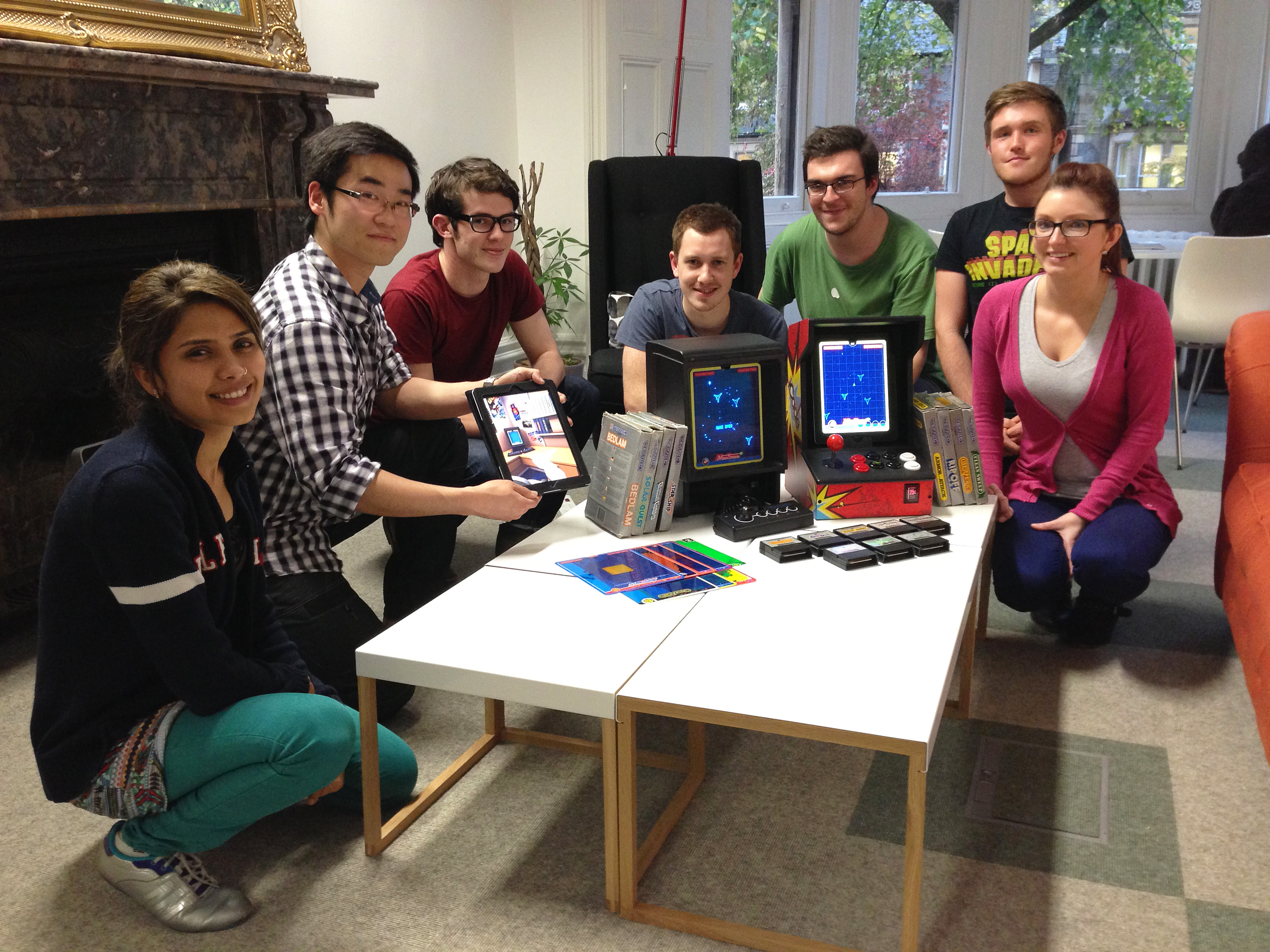
The original Vectrex (left) and the iOs recreation, seen with an iCade
Anybody who played on classic cabinets like Asteroids or Lunar Lander
in the arcades knows that those games' unique, glowing-line graphics
were impossible to replicate on standard TV video game consoles. That's
because those and many other arcade games used vector monitors, which
use a fast-moving electron beam to draw images made up of sharp,
straight white lines on a phosphorescent screen. While these vector
monitors have trouble with things like color and solid, filled objects,
they can create easy-to-rotate figures that were much sharper and
cleaner than the low-resolution raster graphics of the time.
In 1982, a company called General Consumer Electric brought the
vector graphics experience to the home for the first and only time with
the Vectrex, a short-lived, semi-portable game console that was actually
came with a small vector monitor of its own. Now, 30 years later,
Rantmedia Games is trying to bring the vector experience home again with Vertex Regeneration, a remarkably authentic iPad emulator for the largely forgotten system. Regeneration is a bit of a labor of love for Anton Faulconbridge, who was inspired to pursue the project after seeing an iCade
and noting its passing resemblance to the Vectrex he enjoyed so much in
his youth. "It's the kind of app that I knew that I wanted and I knew
that I would buy in an absolute heartbeat if someone else had done it,"
Faulconbridge told Ars Technica. But it's more than just nostalgia. "I
think if you had a reasonable childhood, you kind of look back and think
it was amazing, but that's not the reason here. The games are actually
good and I think they actually translate well."
Indeed, the games on the Vectrex are quite different from the other
retro gaming collections on iOS, characterized by high-resolution line
drawings with smooth rotations and vibrant animations. The Vectrex's 28
game library was primarily made up of thinly-veiled copies of popular
arcade games of the time, but what many in the title lack in originality
they make up for in pure addictiveness and quality design.
Emulation issues
/ Pack-in game Minestorm shows off the Vectrex's unique graphics.
Recreating the sharp, glowing lines of a real Vectrex on a standard
LCD display presents a challenge for anyone taking on this kind of
emulation project, Faulconbridge noted. "It's a totally unique system,
it is so analog, this phosphor screen that kind of pulses, it's almost
alive, and it's incredibly difficult to turn something that feels so
analog into something that is actually digital."
That said, Faulconbridge adds the display technology on the latest
iOS devices is getting to the point where an LCD screen can display
lines that are nearly as crisp and clean as a vector display. "The
retina displays that we've got now, it's almost the perfect time for
this vector system really, because we're finally getting to the point
where we're getting closer than ever to the look and feel of the
original vector graphics," he said. "I think it's the best out there in
terms of the results that you get, and when Apple gives us an even
higher resolution screen we'll do even better."
Creating an authentic experience also means replicating some of the
Vectrex's less desirable features. Because the Vectrex's oscillating
electron beam can only be in one place at one time, there's a noticeable
flicker as you watch the system actually draw each frame of the scene
at a rate slightly slower than the human eye can process. This
flickering is a key component of the authentic Vectrex experience for
fans of the original system, but it might be frustrating (not to mention
seizure-inducing) to a modern audience without the benefit of
nostalgia.
For the iOS emulator, Faulconbridge came to a compromise that lowered
the flickering but didn't remove it altogether. "The reduction in
flicker is down to using some crazy complicated shader code that
persists the lines on the screen for a little longer than they would
have been on the original Vectrex," he said. "We wanted to make it as
accessible as possible to the widest possible audience. While lots of
flicker might be authentic, it's not necessarily something you'd notice
missing if it's not there."
And then there are the little bits of retro authenticity that don't
come from intentional design, but from the physical vagaries of the old
hardware itself. "One of the things that's evident on the original
system is, due to the bad design of it, a lot of them will hum—you turn
them on and there's this kind of constant hum," Faulconbridge pointed
out to us. "We were talking to the guys following us on Twitter and
through the web site and we said 'Do you want the hum in there?' and
about 95% of them said yes. So we've made it an option. It's not on by
default, but you can turn it on if you want it."
Then there are the bits of presentation that had nothing to do with
the hardware. Vectrex games came packaged with colorful plastic overlays
that were meant to provide the sort of background and border art that
the system itself just couldn't produce. Though Faulconbridge said he
found peeling and reapplying these overlays to be too much of a hassle
in his youth, being able to apply them automatically on the iPad adds
something to the experience, to a point. "We had some strange requests:
some people saying they'd like to be able to use the wrong overlays on
different games.' he noted. "Why would you do that?"
The homebrew community
/ The Rantmedia Games team poses with their creation.
Nobody seems to know just how many Vectrex units were sold all those
decades ago. The system largely flopped at its original $200 retail
price, and was quickly being liquidated in bargain bins during the video
game crash of 1983. Working units aren't impossible to find these days,
and can be had on eBay for about $100.
But despite its small sales and cultural impact, Faulconbridge notes
that there's still a dedicated audience of Vectrex enthusiasts out
there, who have stuck with the system for decades. While there were only
28 commercial games made for the original Vectrex, homebrew coders have
extended that library with dozens of new titles, for use on PC emulators and also as manufactured cartridges. These titles range from recreations of familier arcade titles to real-time strategy games to aversion of the Logo Programing Language.
Some homebrew Vectrex games even use programming tricks to surpass
what was possible on the original cartridges, offering synthesized
speech or surpassing the 4K memory limit, for instance. "A lot of the
original games were done in a very short space of time," Faulconbridge
points out. "You'd have the manager come along and say 'you've got to
ship this game and you've got a week to do it' where the guys that are
doing it now, it's more about pushing things to the edge, and they
really are pushing things to the edge of what the hardware is capable
of, but they've got time to really perfect it and get it right." Four of
these homebrew titles are already available through Vectrex Regeneration, and more will be offered both as free and paid downloads in the future, Faulconbridge said.
With total control of the Vectrex name and branding, Faulconbridge
said he's had some thoughts about tracking down some old vector monitors
and trying to create a new line of actual Vectrex hardware. For now,
though, emulation is also a way to preserve the memory of those games
without risking the original hardware. As spokesperson David Tractenberg
says, every time he turns on his launch era Vectrex, he worries that "a
stray piece of dust has gone in there when I turn it on and it's going
to go 'Boosh' and that'll be that... Right now my Vectrex is like a
Schroedinger's cat, it's both dead and alive at the same time on my
shelf." With Regeneration, Tractenberg says, he can "recreate his vector days as a kid without risking his actual Vectrex."
The app did not figure when the new iOS 6 was released in September
Google has made its Maps app available on the Apple App Store, after Apple stumbled with its own maps application.
The
Google Maps app became available late Wednesday for Apple's iPhone and
iPod touch. "Starting today, we're pleased to announce that Google Maps
is here--rolling out across the world in the Apple App Store," Daniel
Graf, director of Google Maps for Mobile, wrote in a blogpost.
Google
said the free app has been designed from the ground up "to combine the
comprehensiveness and accuracy of Google Maps with an interface that
makes finding what you're looking for faster and easier." The app has
been optimized for the iPhone 5.
The app features voice-guided turn-by-turn navigation, Google's Street View and live traffic conditions.
Apple,
which had shipped Google's mapping application with the iOS operating
system, replaced it with its own mapping application in the new version
iOS 6 which was released in September. The application was however found
to have glitches, which led Apple's CEO Tim Cook to apologize for the
frustration caused to customers.
Police in Mildura town in the Victoria state of Australia advised people earlier this week not to rely on the application after motorists were misguided to a semi-arid national park.
The
new Google Maps app is available for the iPhone and iPod touch
fourth-generation, iOS 5.1 and higher, in more than 40 countries and in
29 languages, including Chinese, Dutch, English, French, German,
Italian, Japanese and Spanish, Google said.
Google also released
Wednesday a Google Maps SDK (software development kit) for iOS for
developers to feature Google Maps in their applications for the iPod
touch, iPhone, and iPad. An iOS app can also launch the Google Maps for
iPhone app using a URL scheme, which allows for the launch of a native iOS application from another iOS app or a web application.
Apple and Microsoft's relationship has had more twists and turns
than Liz and Dick's. The two have been bitter rivals, vital partners --
even coolly indifferent. Microsoft's new surface tablet could change things again. Apple's iPad has some 55% of the market. Amazon (AMZN) and Google (GOOG) have largely offered cheaper alternatives to compete. But Microsoft (MSFT) is taking Apple (AAPL)
on directly: The Surface sells for a premium price. And analysis by
firm IHS iSuppli suggests that Microsoft's -- not Apple's -- device has
higher margins. If things go well, Microsoft could capture some 9% of
sales by 2016, Gartner Research estimates. That's still far behind
Apple, but not bad for a latecomer. Here's a look at what goes into
making the two devices.
Note: Microsoft Surface RT with 32GB of storage and
third-generation Apple iPad with 32GB of storage pictured. Cost of parts
includes prices of components not listed, but not cost to manufacture.
Source: IHS iSuppli